Global warehouses are entering 2026 under stronger pressure to improve safety, density, and operating speed. Grand View Research estimates that the global warehouse racking market reached approximately USD 8.6 billion in 2023. Its forecast also indicates steady expansion through 2030, driven by e-commerce, automation, and modern distribution networks.
The demand is practical. A busy pallet aisle needs more than extra steel. It needs protection against forklift impacts, shifting loads, and repeated daily movement. Impact Racks can help reduce damage around uprights, end frames, corners, and pedestrian zones. However, protection equipment cannot correct poor load planning or damaged rack components.
Safety remains measurable. OSHA 29 CFR 1910.176(b) requires stored materials to remain secure against sliding, falling, or collapse. The Rack Manufacturers Institute also promotes engineering-based inspection and maintenance practices through ANSI-approved guidance. These references matter because a visually strong rack may still have hidden deformation.
MHI’s 2024 Industry Report found that 83% of supply chain professionals viewed innovation as a competitive advantage. That finding supports investment in smarter storage protection, but it does not guarantee a suitable purchase. Site traffic, pallet weight, rack geometry, floor condition, and local standards must be checked together.
This guide examines the top Impact Racks for global buyers in 2026. It compares protection design, materials, installation methods, visibility, maintenance, and total ownership cost. No shortlist is perfect. Product claims need verification through drawings, test evidence, and supplier experience. A rack guard that looks impressive may still fail in a narrow aisle. That detail matters.
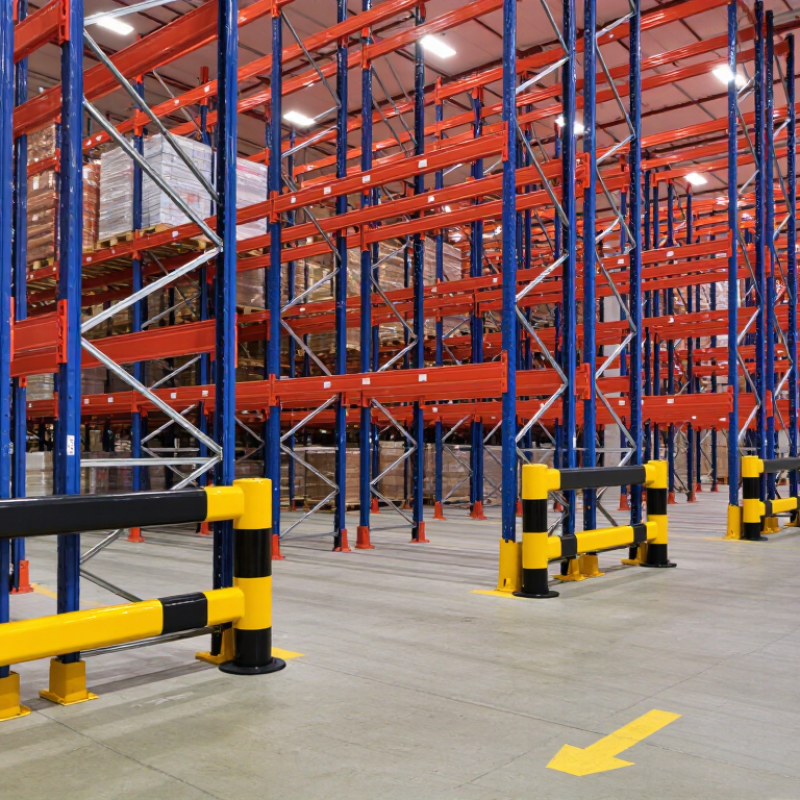
Impact racks are pallet storage systems designed to absorb or limit damage from forklifts, pallets, and handling equipment.
They commonly include reinforced uprights, column guards, end-of-aisle barriers, and replaceable safety components.
Picture a busy warehouse aisle: a loaded pallet moves overhead while a forklift turns sharply below. Small impacts can become expensive failures.
Global buyers need these systems because warehouses are becoming denser, faster, and more automated.
The MHI 2024 Annual Industry Report found that 55% of supply chain professionals expect rising customer expectations to influence operations.
Meanwhile, Grand View Research valued the global warehouse automation market at about USD 23 billion in 2023.
More movement creates more opportunities for contact damage. Impact protection therefore supports rack stability, product safety, and maintenance control.
Buyers should verify load ratings, steel thickness, anchoring methods, beam connections, and replacement access.
EN 15635 recommends regular rack inspections and immediate action after serious damage. That matters across international projects, where installation quality can vary.
A rack may look strong but still fail after poor anchoring or uneven floors. This is where experience becomes important.
Specify protection for actual traffic patterns, not attractive catalog images.
Some facilities may also overprotect low-risk zones, wasting budget. A practical review of forklift routes, pallet weights, aisle widths, and local safety requirements should guide the final selection.
Impact-ready pallet racks differ mainly in how they store loads and resist operational forces. Selective racks use two upright frames, horizontal beams, and diagonal bracing. They provide direct access to every pallet, but exposed corners need steel guards and secure floor anchors. This layout suits mixed inventory and frequent picking.
Drive-in racks remove many aisles by using deep storage lanes with support rails. Forklifts enter the structure, so uprights face greater contact risk. Push-back racks use inclined carts or nested rails. Pallets move backward as new loads enter, creating higher density without full forklift entry. Pallet-flow racks rely on rollers and gravity. They separate loading from unloading, but uneven pallets can interrupt movement.
The structural differences affect safety, capacity, and maintenance. Heavier frames do not automatically make a better system. Beam span, pallet weight, impact speed, floor quality, and forklift clearance must be checked together. In warehouse assessments, I look for bent uprights, loose anchors, scraped paint, and distorted beams. Small damage can hide a serious loss of load capacity.
Mistakes happen. A rack designed for static weight may perform poorly under repeated impacts. Local engineering requirements also vary, so load plaques and inspection records should match the installed structure. Clear aisle markings help, but training remains essential. That detail matters. A practical design often sacrifices a little storage density for safer access and easier inspection.
2026 Top Impact Racks for Global Buyers
How to Evaluate Load Capacity, Safety, and Durability
A reliable impact rack begins with accurate load data, not attractive steelwork. Record each pallet’s weight, dimensions, and loading pattern. Calculate capacity per level and per bay, including uneven loads and forklift impact. Never treat the advertised maximum as a working target. Leave a practical safety margin.
Check the upright frames, beams, bracing, anchors, and floor condition. Ask for engineering calculations, test evidence, and clear installation instructions. I have found that small layout changes can alter aisle clearance and collision risk. Guards should protect vulnerable posts without blocking inspections. Operators also need visible load signs and regular training. Keep it simple.
Durability depends on more than coating thickness. Inspect weld quality, bolt connections, paint damage, corrosion, and beam deflection. Outdoor or humid sites need stronger corrosion control. Replace bent components rather than straightening them on site. That shortcut can hide internal weakness. Monthly checks are useful, but high-traffic warehouses may need weekly inspections. No inspection plan is perfect; missed damage remains a realistic concern. Keep records with photographs, dates, and corrective actions. A competent engineer should review unusual loads, seismic exposure, or major layout changes before the rack is used.
2026 Top Impact Racks for Global Buyers?
Global Standards, Materials, and Compliance Requirements
Impact-resistant storage racks must satisfy more than a stated load capacity. Global buyers should verify design calculations, steel traceability, weld quality, and installation records. EN 15512 supports adjustable pallet rack design in Europe, while ANSI MH16.1 is widely referenced in North America. Local building codes may add seismic or anchoring requirements. Standards can overlap, but they are not interchangeable.
Material selection affects service life. High-strength structural steel can reduce upright weight, yet thicker steel may better resist repeated forklift contact. Powder-coated surfaces suit dry warehouses, while galvanized finishes help in humid or corrosive areas. Ask for yield strength reports, coating thickness data, and batch identification. A visible load plaque should show bay limits, beam levels, and operating conditions.
During warehouse inspections, small details often reveal larger risks. Anchors may be correctly specified but poorly installed in cracked concrete. A beam may pass a factory test, then fail after unauthorized modification. Compliance documents should include drawings, risk assessments, inspection guidance, and competent installer records. Importers also need to check product labeling, language requirements, and country-specific conformity procedures.
No checklist is perfect.
I have seen projects delayed because buyers confirmed steel grade but ignored floor capacity. That oversight is easy to repeat. Independent engineering review remains valuable, especially for high-bay systems, seismic zones, and mixed pallet loads. Regular inspections should record bent frames, missing pins, impact damage, and changes in stored goods.
Representative yield or proof-stress values for materials commonly used in rack frames, guards, and impact-protection components.
Material values are representative reference points: S235JR: 235 MPa minimum yield strength; 304 stainless steel: 215 MPa minimum 0.2% proof stress; 6061-T6 aluminum: approximately 240 MPa yield strength; HDPE and UHMWPE: approximately 25 MPa yield strength. Actual values vary by thickness, temperature, formulation, and certification. Rack designs should be verified against applicable requirements such as EN 15635, ANSI/RMI MH16.1, AS 4084, and FEM storage-equipment guidance.
2026 Top Impact Racks for Global Buyers?
How to Select the Right Impact Rack Supplier and System
Choosing an impact rack supplier requires more than comparing steel thickness or quoted prices. Start with your warehouse reality. Measure aisle widths, forklift turning paths, pallet weights, and daily traffic. Ask for load calculations, engineering drawings, and tested impact performance. A reliable supplier should explain how the system handles repeated contact, not only one controlled test.
Check material quality, protective coatings, connection details, and replacement procedures. Request installation guidance and inspection criteria in clear English. For international projects, confirm packaging, delivery terms, spare-part availability, and local technical support. Relevant safety standards may differ by region, so ask the supplier to identify applicable requirements instead of making broad promises.
Tips: Visit a working installation when possible. Examine bent guards, loose anchors, and floor damage. Ask who repairs the system after impact. If the answer is unclear, pause the purchase. A low price can become expensive when parts arrive late or measurements are wrong. I still find that many buyers focus too heavily on initial cost. That is a common mistake. The strongest decision combines verified engineering, practical installation support, transparent documentation, and a supplier willing to admit system limits. No rack is impact-proof. Regular inspections remain essential.
| Rack System | Best-Fit Application | Typical Storage Profile | Operator Impact Exposure | Pallet Selectivity | Space Utilization | Recommended Protection Measures | Key Supplier Verification Points |
|---|---|---|---|---|---|---|---|
| Selective Pallet Rack | Mixed-SKU warehouses with frequent access to individual pallets. | Single-deep pallet storage; compatible with common forklift operations. | High Frequent aisle traffic increases the likelihood of frame and upright contact. |
Very high; normally provides direct access to every pallet position. | Moderate; aisle width and access requirements reduce density compared with compact systems. | End-of-aisle guards Upright protectors Row spacers Load labels | Structural calculations, beam-to-upright compatibility, anchoring design, deflection limits, inspection procedures, and replacement-part availability. |
| Double-Deep Pallet Rack | Operations holding several pallets of the same SKU with moderate turnover. | Two pallets deep; requires reach equipment with suitable reach capability. | High Deeper handling increases positioning and visibility demands. |
Moderate; front pallets may need to be moved before rear pallets are retrieved. | Good; fewer aisles are required than with single-deep selective storage. | Guide rails Upright guards Pallet stops Camera or guidance system | Confirm equipment compatibility, rear-pallet access, beam levels, back-to-back spacing, rack tolerances, and load stability requirements. |
| Drive-In Rack | High-density storage for low-SKU-count inventory with relatively large batch quantities. | Multiple pallets deep and high; forklifts enter storage lanes. | Very high Forklift entry creates repeated risks to uprights, rails, and pallet-support components. |
Low to moderate; usually operates on a last-in, first-out basis. | Very high; minimizes aisles and can use a large proportion of available floor area. | Lane-entry guides Heavy-duty guards Rail protectors Speed controls | Verify tunnel geometry, rail load rating, pallet compatibility, forklift clearance, impact-protection design, and maintenance access. |
| Push-Back Rack | High-density storage where multiple pallets per lane and fast front access are required. | Typically two to several pallets deep on carts or nested rails. | Medium to high Loading and unloading require controlled pallet movement and correct cart alignment. |
Moderate; generally follows a last-in, first-out operating sequence. | High; reduces aisle requirements while retaining better access than drive-in storage. | Cart stops Pallet guides Frame guards Operator training | Check cart capacity, rail slope, pallet dimensions, braking or stop features, service access, and load-transfer calculations. |
| Pallet Flow Rack | High-throughput distribution, order fulfillment, and first-in, first-out inventory control. | Gravity-fed lanes with rollers or wheels; loading and picking occur from opposite sides. | Medium Impact risk is concentrated at loading ends, lane separators, and pallet stops. |
High for FIFO-controlled pallets; access is organized by lane and SKU. | High; supports dense storage with separate replenishment and picking aisles. | Pallet brakes Speed controllers Lane dividers End guards | Verify roller design, pallet-base compatibility, lane capacity, brake performance, stop strength, hygiene requirements, and cleaning access. |
| Mobile Pallet Rack | Cold stores, archives, and facilities where floor area is limited and access frequency is controlled. | Rack rows mounted on powered or mechanically driven mobile bases. | Medium Risk is associated with moving bases, end zones, and incorrect aisle-clearance control. |
High when an aisle is opened; access is sequential rather than simultaneous. | Very high; can reduce fixed aisle space, subject to safety and operational requirements. | Safety barriers Presence sensors Emergency stops Interlocks | Assess floor loading, rail installation, emergency systems, electrical requirements, seismic conditions, maintenance support, and controls integration. |
| Cantilever Rack | Long, bulky, or irregular products such as tubes, timber, panels, and metal sections. | Open-front storage with horizontal arms; generally loaded from the front or side. | High Long loads and side-loading operations can contact columns and arms. |
High for long-product categories when each load type has a designated arm position. | Moderate; layout depends on product length, handling equipment, and required clearances. | Column guards Arm end stops Load separators Aisle barriers | Confirm arm capacity, column stability, base anchoring, load overhang, product restraint, forklift clearance, and maximum allowable eccentric loading. |
| Automated Pallet Storage Rack | High-volume operations using cranes, shuttles, or automated guided equipment. | High-bay, high-density storage with controlled automatic pallet handling. | Low during normal operation Impact risk remains significant during commissioning, maintenance, and manual intervention. |
High when warehouse control software manages pallet locations. | Very high; supports dense vertical storage and narrow operating corridors. | Collision detection Safety fencing Interlocked gates Remote monitoring | Review seismic design, machine clearances, fire protection, control-system interfaces, emergency recovery, maintenance access, and lifecycle support. |
Impact racks are pallet storage systems built to limit damage from forklifts and handling equipment. They use reinforced uprights, column guards, and aisle barriers. Replaceable safety parts can reduce repair time.
Warehouses are becoming denser, faster, and more automated. More pallet movement creates more contact risks. A small forklift strike can damage a frame, pallet, or stored product.
Check load ratings, steel thickness, beam connections, anchoring methods, and replacement access. Review forklift routes, pallet weights, aisle widths, and floor conditions. Attractive catalog images are not enough.
Dry warehouses may suit powder-coated surfaces. Humid or corrosive areas may need galvanized finishes. Uneven floors and weak concrete can undermine good rack designs.
Request design calculations, steel traceability, weld-quality records, and installation documents. Ask for coating data, batch identification, drawings, and risk assessments. Keep competent installer records.
Confirm that anchors match the approved design. Inspect cracked concrete, missing pins, bent frames, and impact marks. Also check the visible load plaque and stored goods.
They support rack design, load calculations, anchoring, and inspection practices. Regional requirements may differ. They should not be treated as interchangeable.
Yes. Low-risk zones may receive unnecessary protection. That wastes budget. Review actual traffic patterns before selecting every barrier and guard.
Inspect them regularly and after serious impacts. Record damage, unauthorized changes, and altered pallet loads. Immediate action matters. No checklist is perfect.
Do not verify steel grade while ignoring floor capacity. That mistake is easy to repeat. Independent engineering review is useful for high-bay systems and seismic areas.
Impact Racks are essential warehouse systems designed to protect storage areas from accidental impacts caused by forklifts, pallet movement, and daily material-handling operations. In 2026, global buyers need to understand how different rack types, frames, guards, and modular configurations respond to various warehouse layouts and operating conditions. The right structure can improve safety, maximize usable space, and support more efficient inventory handling.
When evaluating Impact Racks, buyers should carefully review load capacity, structural stability, impact resistance, durability, and maintenance needs. Material quality, protective coatings, manufacturing consistency, and compliance with applicable regional safety standards are also important. A reliable supplier should provide clear technical specifications, installation guidance, inspection support, customization options, and dependable after-sales service. By comparing system design, total operating value, and compliance requirements, global buyers can select an Impact Racks solution that supports long-term warehouse safety and performance.

Xinmiao Storage